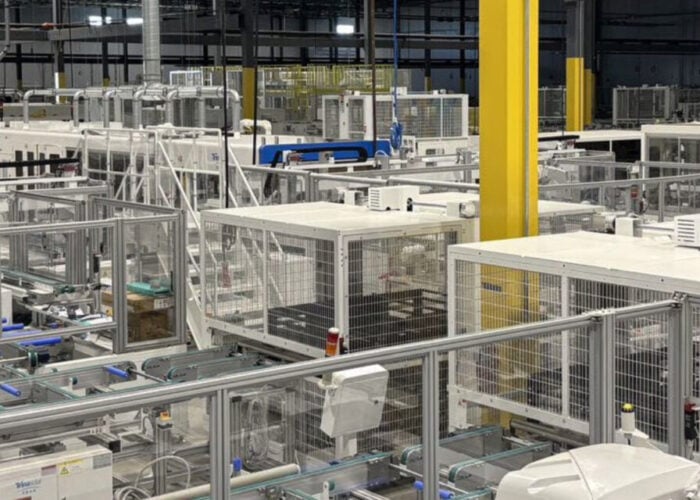

US solar manufacturer Corning has started ingot and wafer production at its Michigan plant, during the third quarter of 2025.
Ramping up is expected to continue during Q4 2025, with the company expecting daily production of wafers to jump from thousands to more than one million in the last three months of 2025. Corning plans for its US-based production to drive US$2.5 billion in revenue by 2028.
Try Premium for just $1
- Full premium access for the first month at only $1
- Converts to an annual rate after 30 days unless cancelled
- Cancel anytime during the trial period
Premium Benefits
- Expert industry analysis and interviews
- Digital access to PV Tech Power journal
- Exclusive event discounts
Or get the full Premium subscription right away
Or continue reading this article for free
Corning has already sold out all the polysilicon and wafer capacity for this year and secured purchases of more than 80% of its available capacity for the next five years.
The news comes nearly a year after the company unveiled plans to build a solar ingot and wafer manufacturing plant in Michigan, near the polysilicon manufacturing plant of its subsidiary Hemlock Semiconductor.
Wendell Weeks, president and CEO at Corning, said: “Over the last 18 months, we have built the largest solar ingot and wafer facility in the United States, co-located with our polysilicon manufacturing facility in Hemlock, Michigan. It was a significant undertaking.”
Weeks added during an earnings call that the company’s area of focus will be ingots and wafers, while sourcing the solar cells from other US producers. He added that: “We also wanted to have a go-to-market position in modules, primarily because we have some new innovations to bring to that, that could increase the conversion efficiency and provide some of the best products or maybe the best product in the world for solar is our hope.”
Corning bringing online its wafer plant also marks the return of solar wafer production in the US in nearly a decade.
“For the first time, a module can be completely US-made, from polysilicon to the module. This is probably the first time in a long time that this is possible. It might not be sufficient to meet demand, but it is a big step for US manufacturing,” said Moustafa Ramadan, head of market research at PV Tech Research.
A clear example of this is the supply agreement signed between Corning and US solar manufacturer T1 Energy in August of this year. In that deal, Corning would supply US-made polysilicon and wafers to T1 Energy, which aims to begin construction of its 5GW solar cell production plant in Q4 of this year and has already started assembling modules at its Dallas plant.
US passes 60GW of annual module nameplate capacity
Corning ‘s start of operations at its wafer plant in Michigan is the latest milestone for the US solar manufacturing industry in the past twelve months. Late last year, solar cells were manufactured for the first time in five years on US soil, and it currently sits at 3.2GW of annual nameplate capacity, more than trebling the capacity from 2024, according to US trade body the Solar Energy Industries Association (SEIA).
Furthermore, in February of this year, SEIA said the US had surpassed 50GW of annual nameplate capacity for modules, as shown in the chart below. Between that announcement and now, annual nameplate capacity for modules has increased by a further 10GW.
The growth in solar manufacturing is not only for the supply chain of modules but also for other solar products, such as inverters. SEIA said that the annual capacity of inverters grew by nearly 50% since the end of 2024, from 19GW to 28GW, while mounting system manufacturing also grew by 14% since 2024 with the addition of 23 new factories.
“We’re seeing strong growth today, but that momentum isn’t guaranteed. If the administration continues down this path, they risk driving investment overseas, stifling job creation, raising costs on consumers, and handing America’s manufacturing advantage to our competitors,” said Abigail Ross Hopper, president and CEO of SEIA, who recently announced she will step down from her positions in January 2026.
The solar manufacturing industry’s pipeline has 23GW of modules, more than 34GW of solar cells and 25GW of inverter capacity either under construction or announced, according to SEIA.
Furthermore, this year alone, 65 new or expanded solar and storage facilities have come online, which brought US$4.5 billion in private investment. Despite the growth in solar manufacturing in recent years, SEIA added that more than 100 factories and over US$31 billion in the pipeline could be at risk “if the Trump administration continues its attacks on solar energy.”
Earnings call transcript from the Motley Fool.